
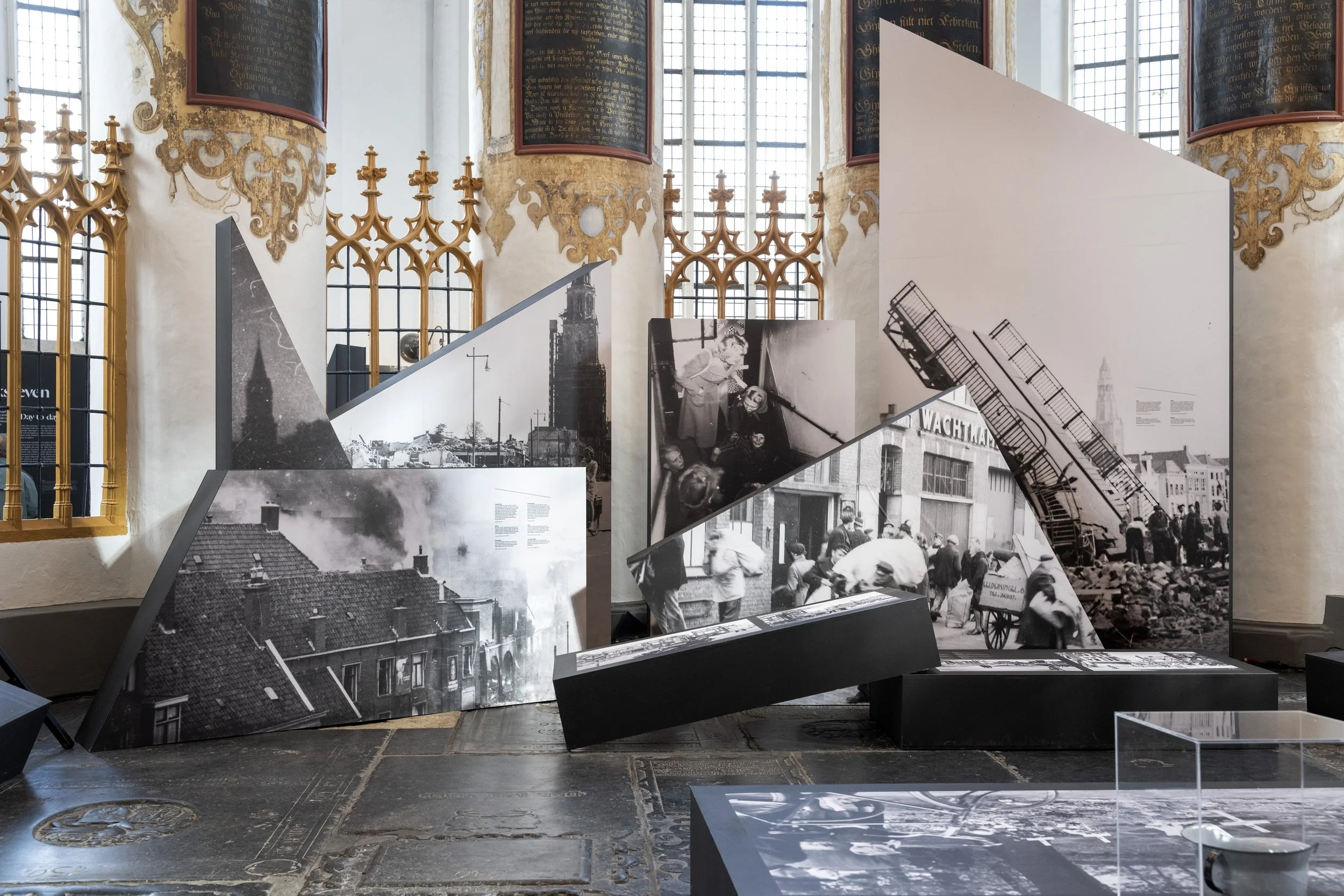
Case Study: Oorlog Dichtbij
An immersive audio exhibition in the A-kerk that makes WWII stories feel emotionally near [1].
Result: visitors linger longer and report deeper connection to local stories (contrast technique: intimate voices ↔ authentic WWII sound).
The Challenge
How do you tell the story of war without turning it into spectacle or relying on the “big” figures of history?
For Oorlog Dichtbij, the challenge was:
To tell big stories through small objects.
To let visitors feel that war was not only Anne Frank or D-Day — but also the silent, confronting stories from their own street, their own neighborhood.
To create an atmosphere that was immersive and emotional, yet respectful and historically accurate.
The Process
Archival Research: Each stop was based on authentic local stories, carefully selected with curators and historians.
Intimate Sound Design: Contrasting authentic WWII vehicles, planes, and weapons with intimate sounds like whispers, footsteps, or a child’s sob created emotional proximity.
Immersive Storytelling: Voices, music, and spatial audio placed visitors inside the stories, surrounding them with layers of history and emotion.
Collaboration: Close work with museum staff ensured a balance between emotional impact and curatorial sensitivity.
-
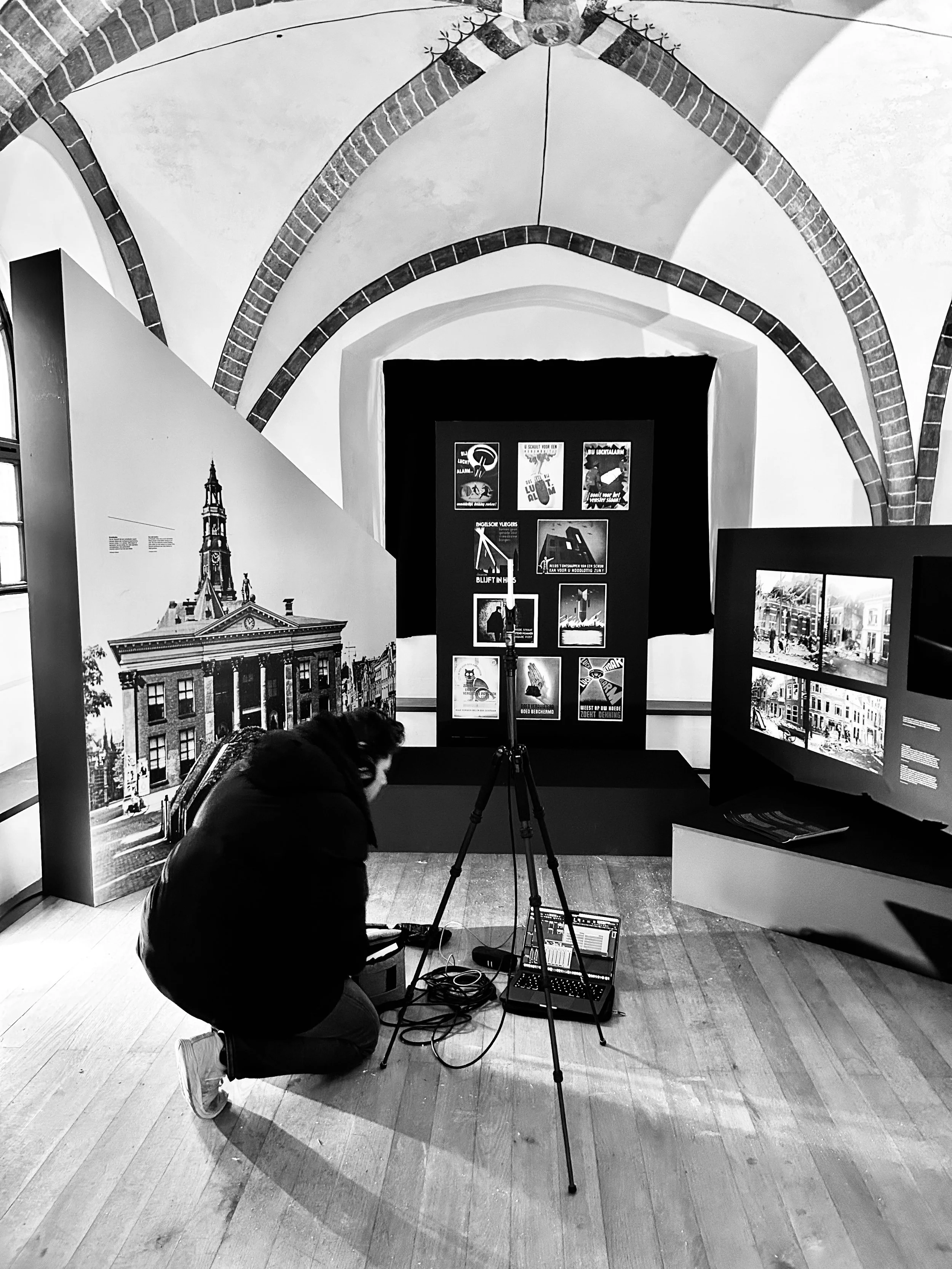
![A person kneeling on the wooden floor, operating audio equipment connected to a laptop, with a large display screen showing architectural images behind them, inside a room with arched brick ceilings.]()
Calibrating the system.
-
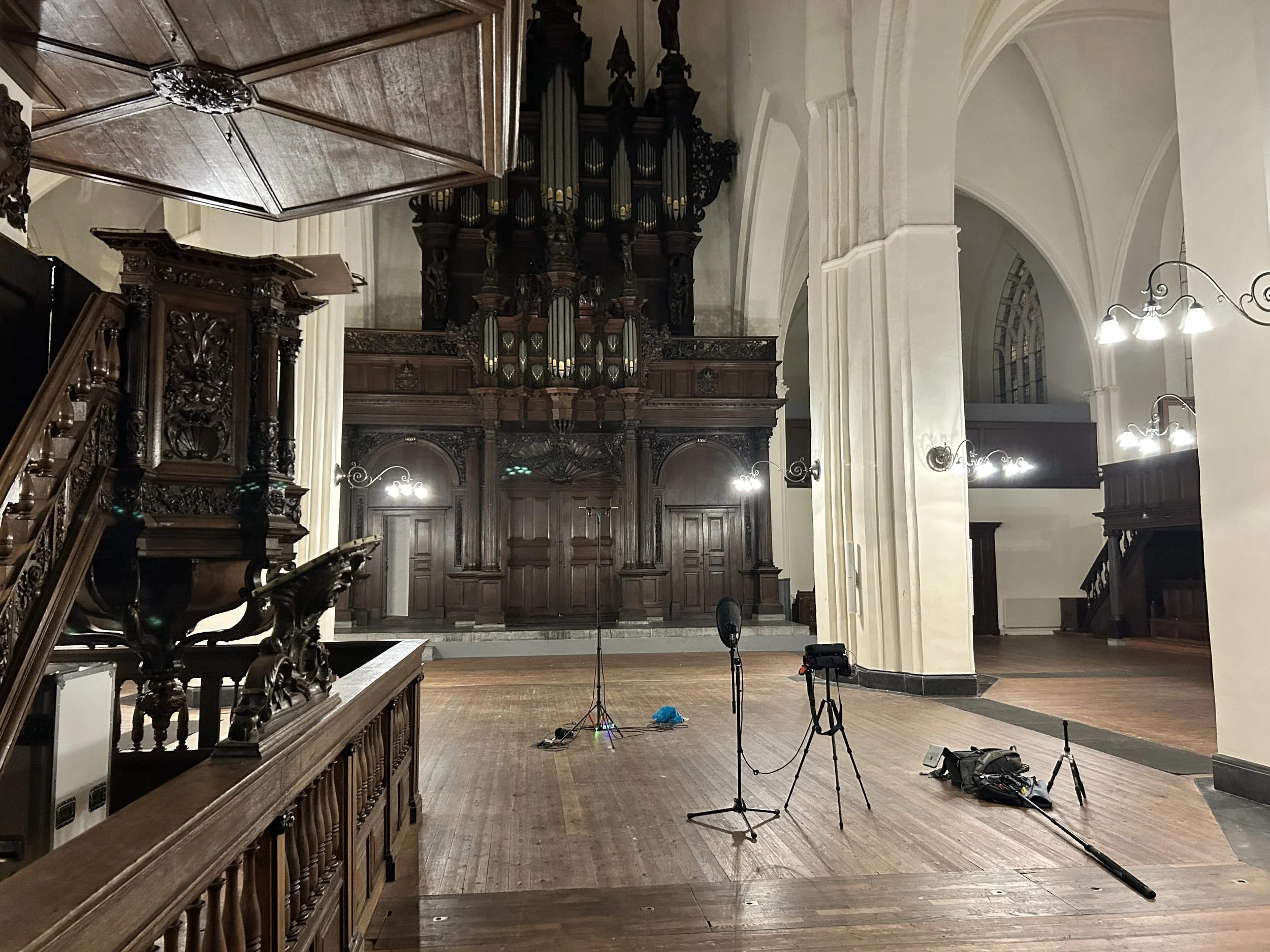
![The image shows the interior of a church or cathedral with high vaulted ceilings, ornate woodwork, large pipe organ, and lighting fixtures. There is equipment set up on the floor, including microphones, tripods, and cables, indicating preparations for a performance or event.]()
Recording the organ.
-
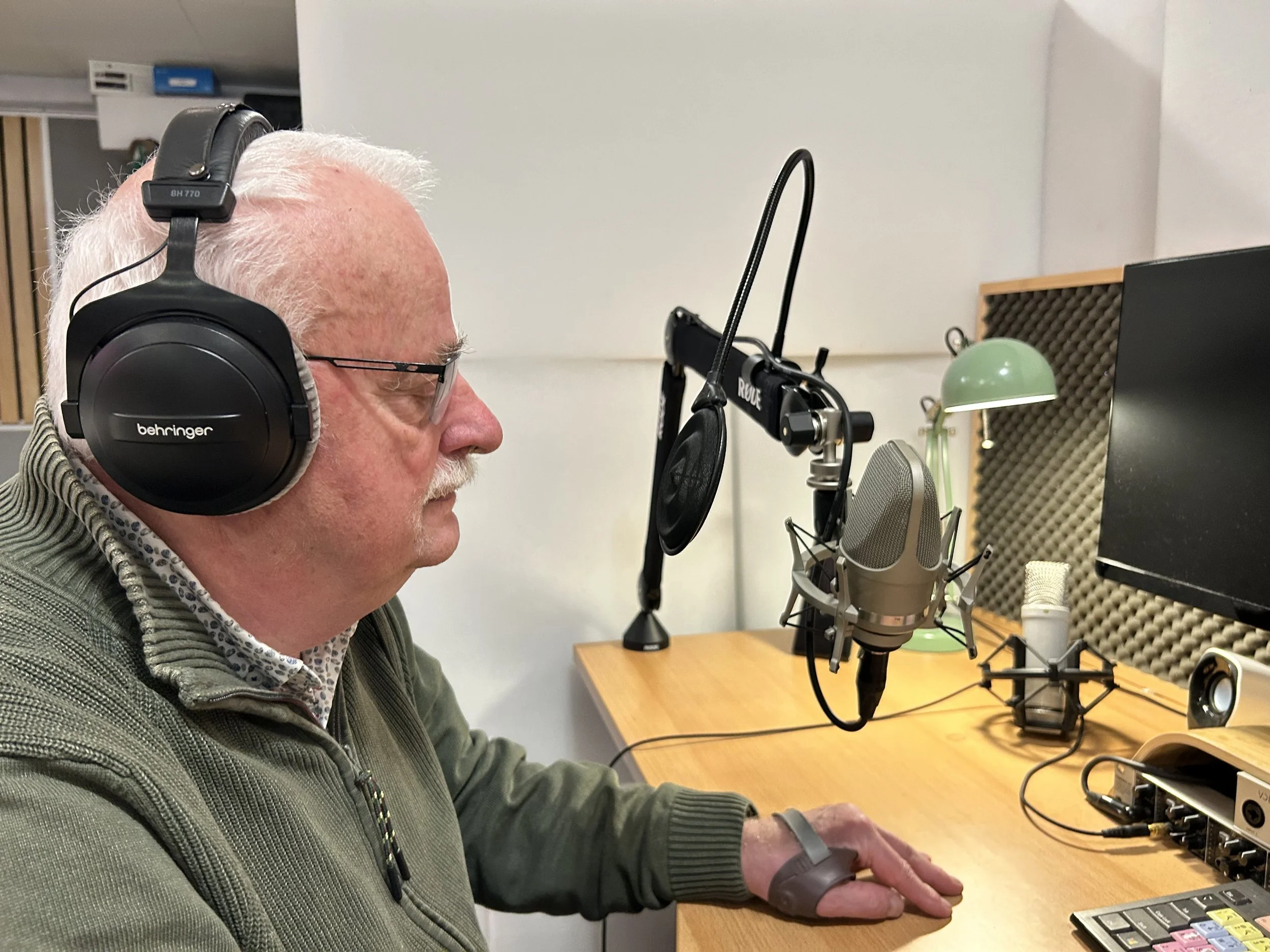
![An elderly man with white hair and glasses wearing headphones, sitting at a desk with audio recording equipment, including a microphone on a stand, a computer monitor, and a control panel with colored buttons.]()
Capturing the stories.
-
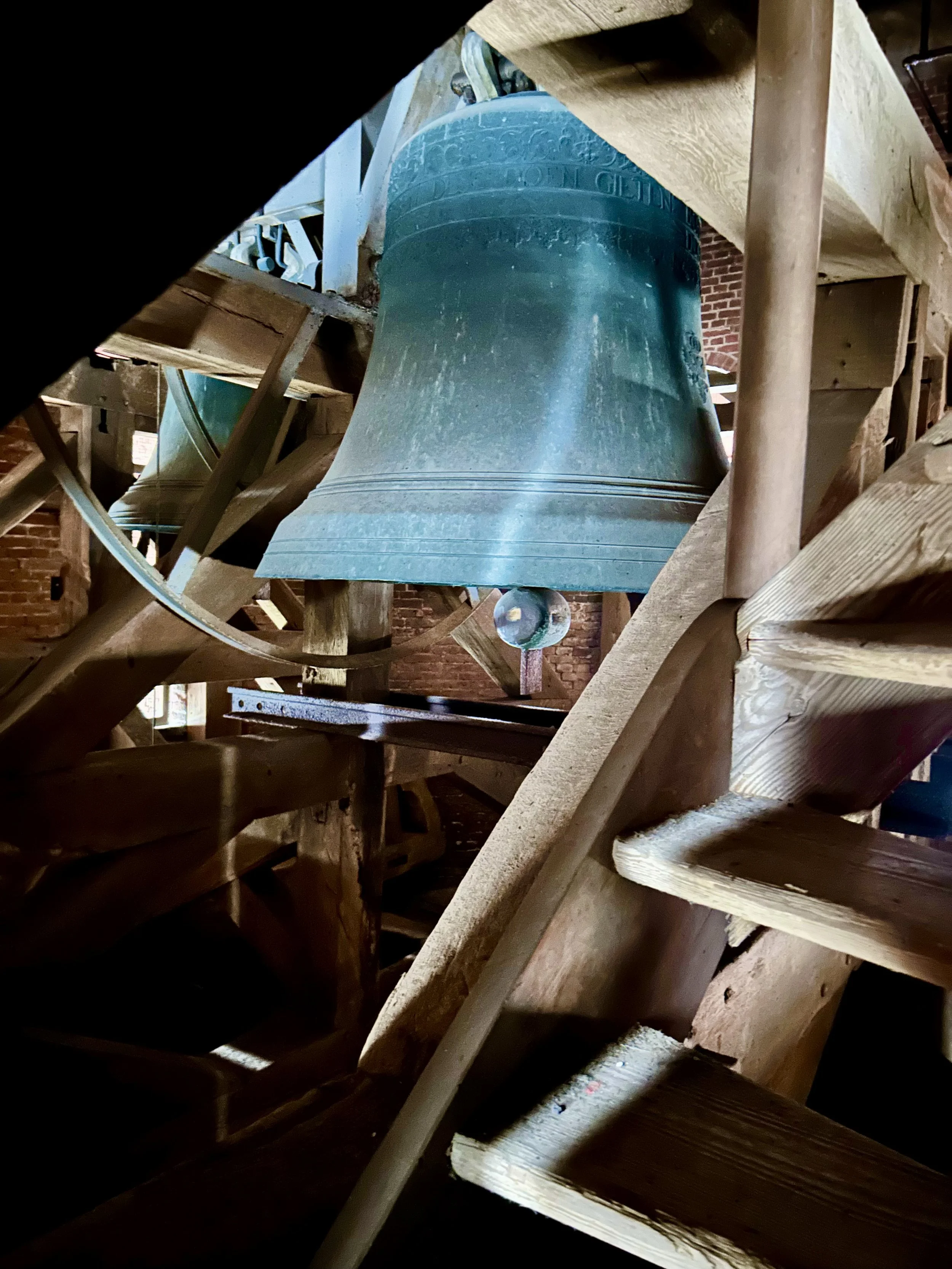
![A large green bell hanging on a wooden frame inside a building with exposed brick walls.]()
Fieldrecording authentic sounds.

The Result & Impact
The exhibition was described as “beklemmend en confronterend” (oppressive and confronting) in the press. Visitors felt drawn into the lived reality of war, realizing it wasn’t only about global events, but about the families and neighbors who once lived in their own city.
“This gave me goosebumps… I saw my parents’ stories come to life.”
“The sound impressed — but didn’t overwhelm.”
“This should be part of every school curriculum.”

The project received two International Sound Awards 2025
(Soundscapes & Ambient Sound • Social & Culture)
recognizing its ability to merge sound, history, and emotional resonance.
Listen.
Partners.
-
![The word 'Akerk' displayed in large, bold black letters on a white background.]()
Exhibition Space
Akerk Groningen
-
![Black text on white background says 'Groninger Kerken' with a simple black outline of a church below it.]()
Client Project
Stichting Groninger Kerken
-
![Black text displaying the names "Paul & Albert" on a white background.]()
Spatial Design Concept
Paul & Albert
Concept and Curation by Martin Hillenga -
![The black text 'taptap' in bold font on a white background.]()
Creative Agency
tapart
Mediaguide Audiotour
Producer




Research & Reference
[1] Savenije, G.M., et al. (2017). Historical empathy in a museum: uniting contextualisation and emotional engagement. International Journal of Heritage Studies. https://pure.uva.nl/ws/files/21700708/Historical_empathy_in_a_museum.pdf
[2] Wiens, K. (2019). How Do We Listen To Museums? Curator: The Museum Journal (special issue on sonic experience). https://onlinelibrary.wiley.com/doi/10.1111/cura.12318
[3] Pecher, D., et al. (2022). Does multisensory study benefit memory for pictures and sounds? Cognition. https://www.sciencedirect.com/science/article/pii/S001002772200169X
[4] Glaser, M., et al. (2025). Spatial vs. normal audio guides in exhibitions: learning outcomes in an experimental setting. TechTrends. https://link.springer.com/article/10.1007/s11423-024-10424-3
[5] Rhee, B.A., et al. (2025). Visitors’ engagement with a museum audio guide: empirical evidence. Museum Management and Curatorship. https://www.tandfonline.com/doi/full/10.1080/09647775.2025.2562849
[6] Greenberg, D.M., et al. (2021). Decreasing stress through a spatial-audio immersive environment: pilot outcomes (affect & stress). Music & Science. Open access PDF. (Supports “sound as therapeutic/affective mechanism”). :contentReference[oaicite:0]{index=0}
[7] Gentile, D., Geffen, R., Atassi, N., Farran, B., Fellas, N., & Oomen, P. (2024). Effects of sound immersion on emotional wellbeing & homeostasis (frequency-dependent effects; ↑ positive affect, ↓ tension). Preprint. :contentReference[oaicite:1]{index=1}
[8] Oorlog Dichtbij — Awards & reach: 2× International Sound Awards 2025; ~10,000 visitors (press/organiser). https://www.groningerkerken.nl/nl/nieuws/2025-9/584/oorlog-dichtbij-bekroond-met-oscars-van-geluid :contentReference[oaicite:2]{index=2}
[9] Oorlog Dichtbij — Project listing / jury abstract (International Sound Directory). https://www.international-sound-directory.com/project/war-up-close/ :contentReference[oaicite:3]{index=3}