
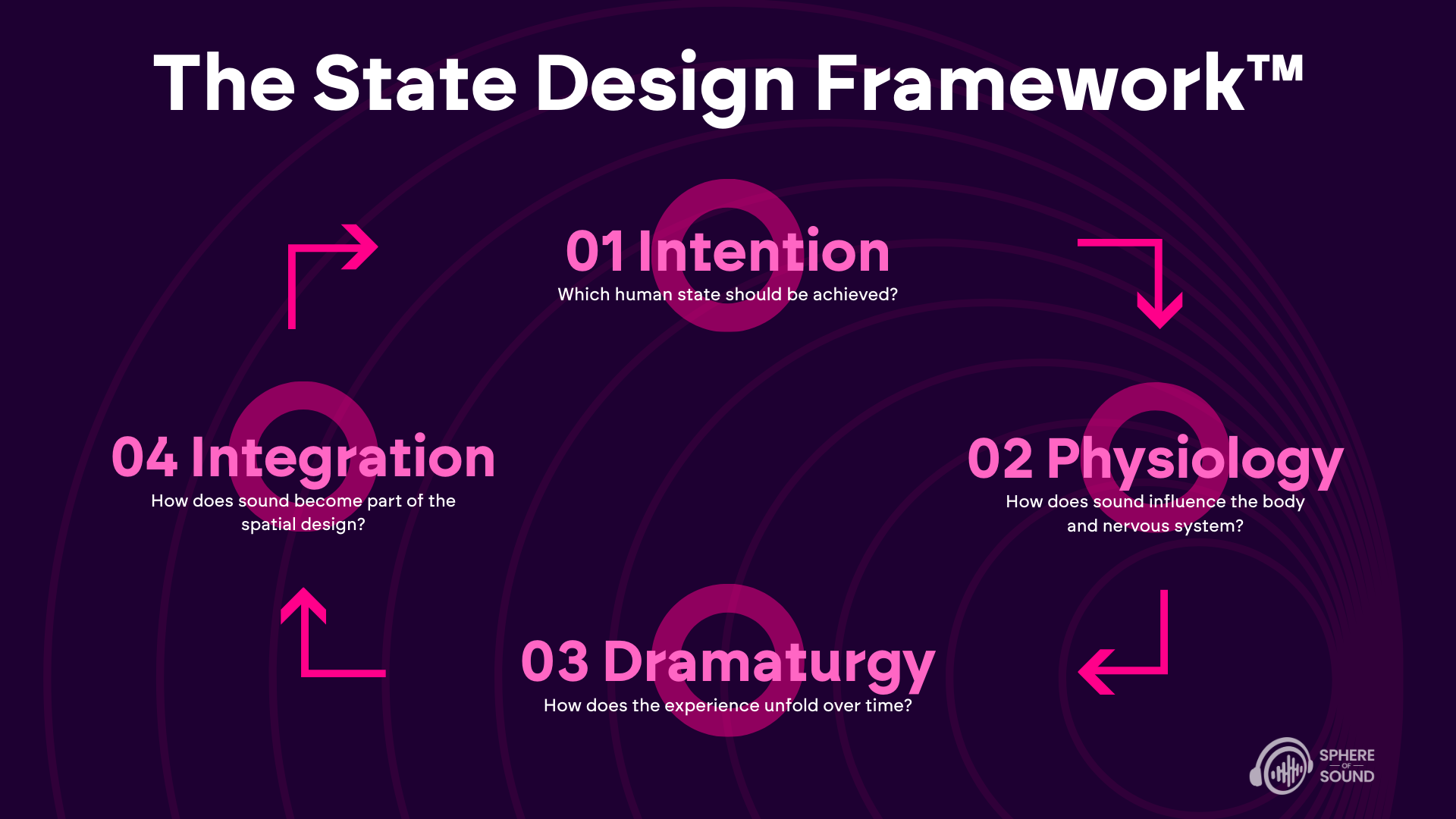
The State Design Framework™
Designing human experience through sound.
Before visitors read a label, look at an artwork or interact with a display, they have already entered a physiological state. That state determines how attention works, how emotion unfolds and what people remember when they leave.
The State Design Framework™ is a structured methodology for designing experiences through sound — from the earliest design phase
The State Design Framework™ consists of four phases.
Together they form a methodology for intentionally shaping human experience through sound.
-
Which human state should be reached?
Focus, curiosity, reflection, tension or activation.
Most projects skip this question and begin with production.
In the State Design Framework™ the intended human state becomes the starting point for every design decision. -
How does sound influence the body and nervous system?
Rhythm, frequency balance, dynamics and spatial movement influence perception before conscious interpretation.
The acoustic properties of the space itself, materials, reverberation and reflections, are part of this phase.
-
How does the experience unfold over time?
Contrast between silence and sound, tension and release, anticipation and surprise shapes the visitor journey.
Sound becomes part of the dramaturgy of the space.
-
How does sound become part of the spatial design?
Sound is not added at the end of a project.
It is integrated into architecture, scenography and visitor flow from the earliest stages of design.
From sound design to experience design
The State Design Framework™ turns sound from a production layer into a design discipline.
Instead of asking:
What should visitors hear?
the framework asks:
What should visitors feel, and how can sound shape that state?