

The Challenge
Creating therapeutic VR environments demands more than visuals. For people to truly relax, the sound has to be convincing, natural, and emotionally grounding. That meant:
Balancing presence and peace: Enough sonic detail to feel alive, but never overwhelming or distracting.
Reconstructing impossible places: Many environments were recorded under difficult conditions. Rebuilding these into clean, convincing soundscapes required extensive layering and creative reconstruction.
Innovating with purpose: Traditional sound design for games or films often uses sound to excite. Here, the task was the opposite: finding new ways of using audio to calm, reassure, and reduce stress.
The challenge was not just technical - it was about proving sound-led VR is associated with reductions in perceived stress and improved affect [2].

The Process
At Sphere of Sound, we approached VRelax with the mindset that sound isn’t background > it’s the backbone of relaxation.
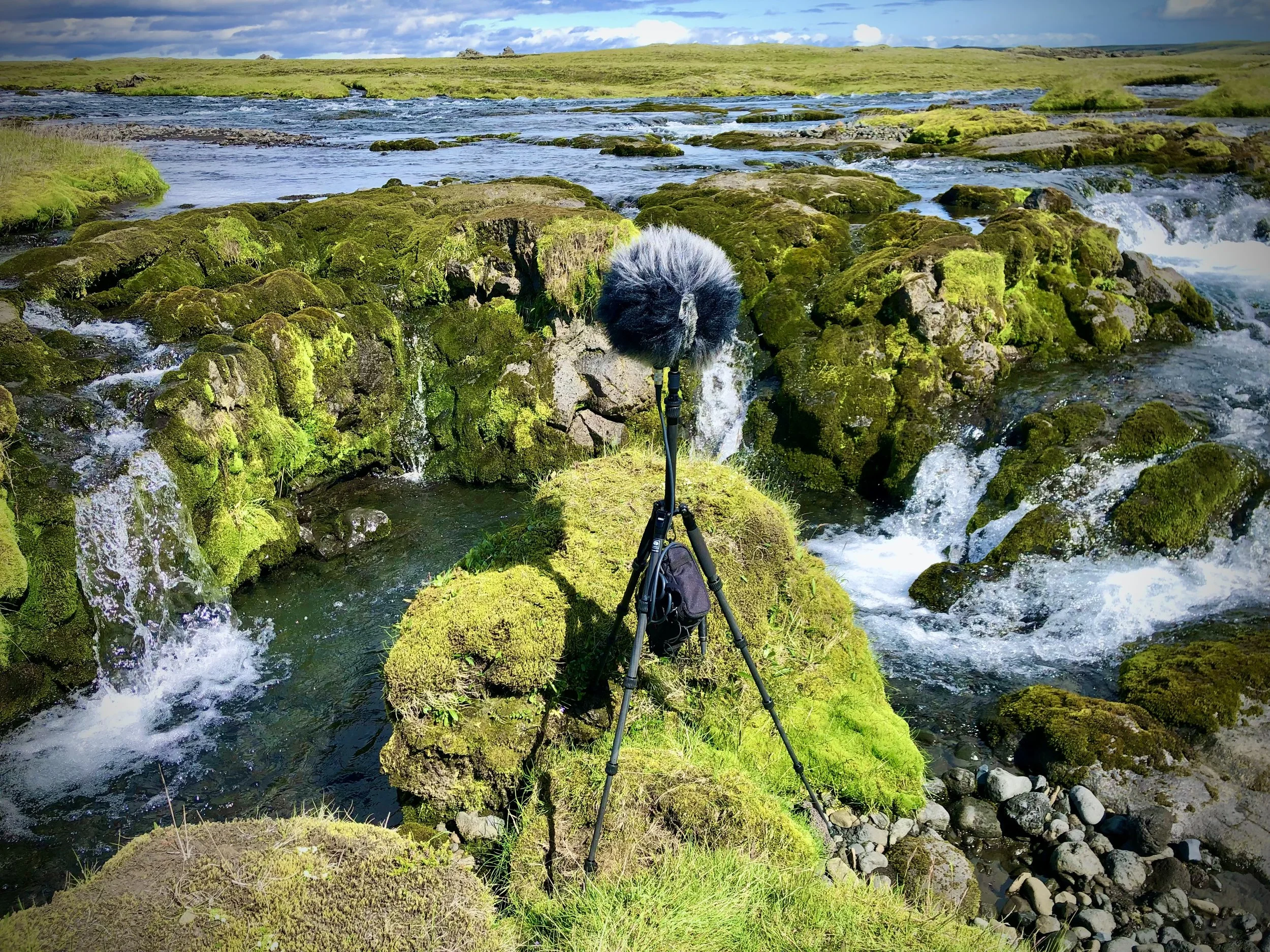
Immersive ambisonic field recordings: Capturing environments in full 360° using ambisonic microphones, then cleaning and sculpting them in post-production.
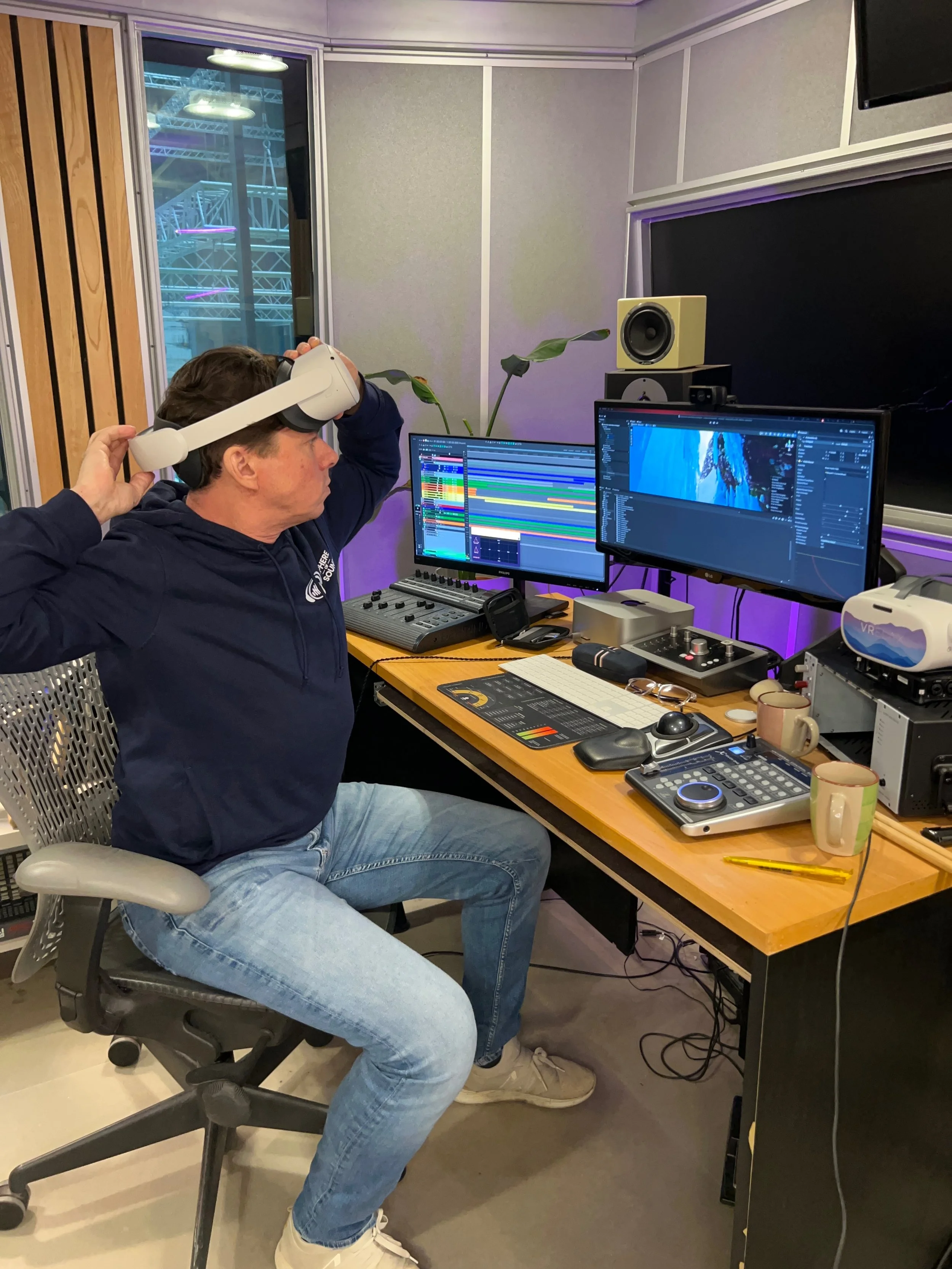
Spatial precision with trueSpatial: Partnering with Atmoky, we positioned sounds exactly where they belonged - every rustle of leaves, every wave, every bird call feels placed naturally in 3D space.
Creative reconstruction: When recordings weren’t usable due to noise pollution, we rebuilt entire soundscapes from scratch, layering recordings, synthesized textures, and foley to create believable yet calm sonic worlds.
Therapeutic soundscapes: Drawing on psychology and neuroscience, we fine-tuned frequencies, dynamics, and pacing to guide users into relaxation without them ever feeling “guided.”
This process made VRelax one of the first VR platforms where sound was deliberately designed as the therapeutic core - not an afterthought.
-
![Sennheiser AMBEO ambisonic microphone in a cinela windjammer and a sound devices mixpre6 mkII recording a stream in a beautiful landscape of Iceland.]()
Capturing Iceland.
-
![animated scene of a CGI modelled xylophone]()
Music Therapy Concept.
-
![Field recordist standing near an ambisonic recording rig, recording the ambience of an stream iwith small waterfalls in Iceland.]()
Recording water.
-
![audio technician with VR headset behind studio desk working in Unity and doing sound design for VR experience]()
Spatial Audio Integration.
-
![Woman with VRelax VR goggles moved by the experience.]()
Client feedback.


The Result & Impact
Clinical validation: Independent studies show immediate stress reductions of ~40% after ~10 minutes [1].
Adoption in healthcare: Deployed across hospitals, mental health institutions, and rehabilitation centers in Europe.
Proven behavioral change: On acute psychiatric wards, a pilot study reported ~50% fewer violent incidents and restrictive practices after introducing VR relaxation. [Riches et al., Psychiatry Research, 2023]
Scale: Over 11,000 sessions per month [internal usage analytics, 2025] and growing - making VRelax a leader in VR mental wellness.

Winner of the Prix Galien MedTech Innovation Award, widely considered the “Nobel Prize” of medical technology.
Research & References
[1] Nijland, J.W.H.M., Veling, W., Lestestuiver, B.P., & van Driel, C.M.G. (2021). Virtual Reality Relaxation for Reducing Perceived Stress of Intensive Care Nurses During the COVID-19 Pandemic. Frontiers in Psychology, 12, 706527. https://doi.org/10.3389/fpsyg.2021.706527
[2] Greenberg, D.M., Fricke, K., Bodner, E., & Shrira, A. (2021). Decreasing Stress Through a Spatial Audio and Immersive 3D Environment: A Pilot Study with Implications for Clinical and Medical Settings. Music & Science, 4, 1–16. Open access repository: https://www.repository.cam.ac.uk/items/016ad701-dcc0-4982-99b0-b99ea7a1c44f (PDF: https://www.repository.cam.ac.uk/bitstreams/68929b16-8df3-4015-b1a1-c73177b26d74/download)
[3] Riches, S., Nicholson, S.L., Fialho, C., et al. (2023). Integrating a Virtual Reality Relaxation Clinic within Acute Psychiatric Services: A Pilot Study. Psychiatry Research, 329, 115477. https://doi.org/10.1016/j.psychres.2023.115477
[4] Riches, S., Kaleva, I., Nicholson, S.L., et al. (2024). Virtual Reality Relaxation for Stress in Young Adults: A Remotely Delivered Pilot Study in Participants’ Homes. Journal of Technology in Behavioral Science, 9, 771–783. https://doi.org/10.1007/s41347-024-00394-x
[5] UMCG — Relax-XL: Zelfmanagement bij stress en slaap (ongoing research program on VRelax effectiveness and implementation). Overview pages: https://www.umcg.nl/-/relax-xl and https://umcgresearch.org/w/vrelax
Listen.
Why It Matters
VRelax demonstrates that sound is medicine [2]. By shifting how we think about audio - not as background but as a therapeutic tool - we opened a new path for mental health support. It’s a project that proves how sound design can have a measurable, positive impact on people’s lives.
Partners.
-
![Abstract digital graphic with blue and purple geometric shapes and patterns.]()
VRelax
Scientifically validated VR Mental Health application
-
![Black logo of a geometric crystal shape next to the word 'atmoky' in lowercase black letters.]()
Atmoky
-
![UMCG logo with a stylized fish and orange pixelated heart.]()



Further reading
Frontiers ICU nurses (2021) [1].
Work with us.
Immersive sound for recovery; non-invasive, soothing, and designed with clinicians to reduce stress and improve patient comfort.